Adele Aldridge on June 28th, 2009

Hexagram 09-glyphLines

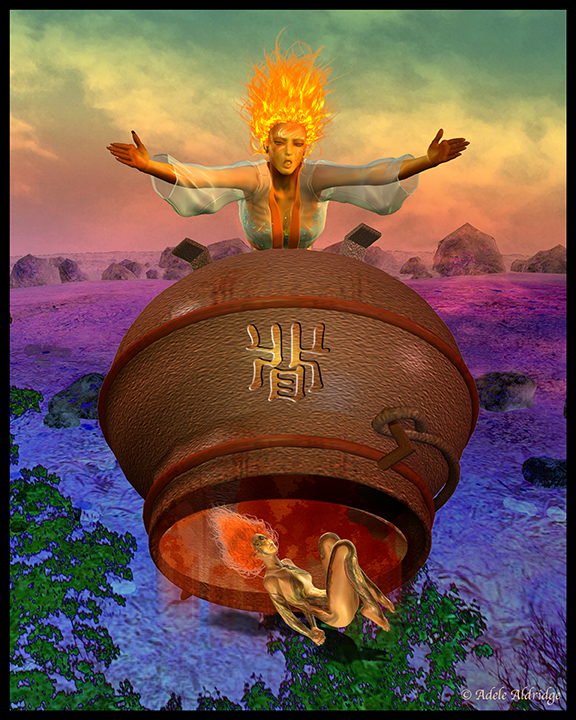
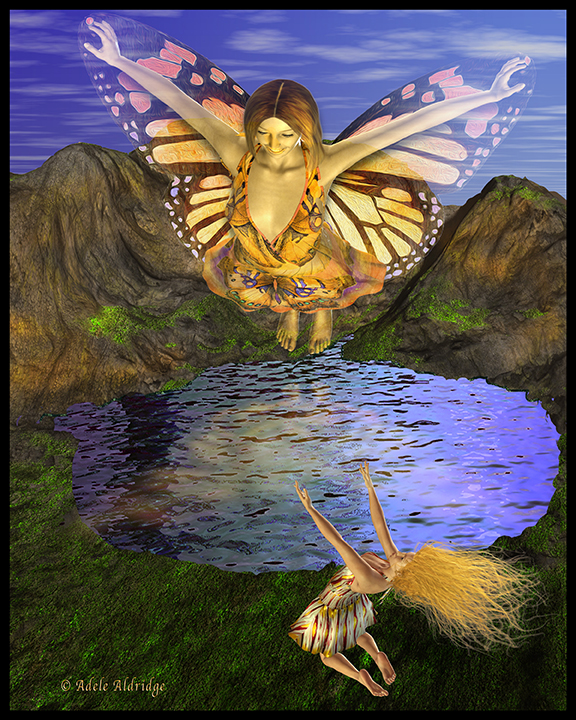
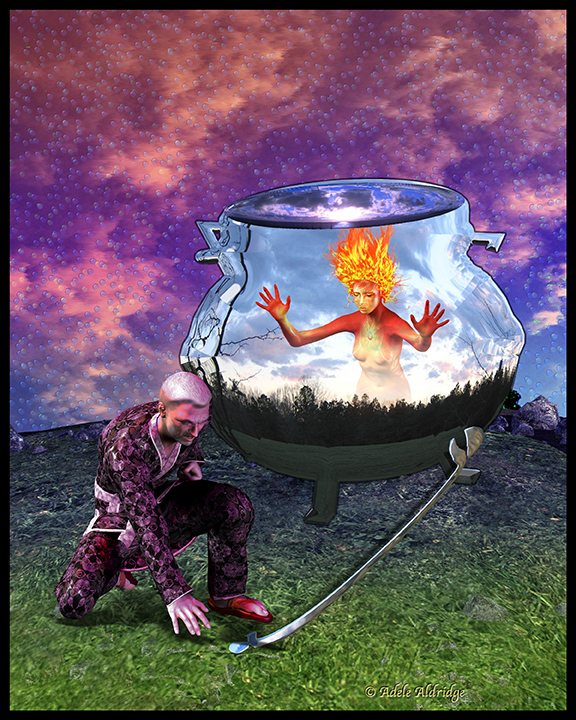
The Image of Wind and Wood in Heaven

I Ching, Hexagram 9-Image

I am the restraint of the tension
In the moment
Before it all happens.
I am the power of one’s shadow.
I am a seed in germination.
I am moisture
In diffuse suspension
Before the cloud bursts.
I am the force in the wind
Gathering the rain.
I am the forgotten dream
That influences the day.
I am the moment
Before the full moon.
I am the spirit of
Wind in Heaven.

Tags: , ,

Adele Aldridge on May 26th, 2009

My first I Ching font contains the lines for the 64 hexagrams, including the trigrams, bi-grams, single lines, and changing single lines which can be found HERE or in in my Resources link.

This new font  contains the 64 hexagrams in Chinese glyph form. I included in the new  I Ching font the single changing lines and bi-grams that are in the font with the hexagram lines. So if you have another I Ching font with the lines, and would just like these extras not included in any other I Ching font that I saw and you would like the Chinese glyphs as well, then this is a good font for you.

Click on the diagram to take you to the link where you can buy the font.

hexagrams chinesemap 2

Tags: ,

Adele Aldridge on May 21st, 2009

Terry Starbucker’s wrote on his blog about an experience he had at the recent SOBcon conference in Chicago an article called, It’s Like Breathing. In it he asked the question of himself,

“What’s like breathing to me? What are those things that help define who I am but are yet rarely thought about, because they come so naturally?”

Terry’s article reminded me of what I wrote for a Blog Carnival, February 1st of this year on the subject of Inspiration. I began my post with the dictionary definition of the word, inspiration. One of the definitions that stood out for me was:

“The act of drawing in, especially the inhalation of air into the lungs.” And I responded with, “… the act of drawing in, is a way I think about inspiration. When I am inspired I draw that person, place or event into myself and then expel it out, like the act of breathing, involuntary and necessary for life.”

Taming porer of the smallIn my post on Inspiration I left out the obvious -  that is, creating or making art, is like breathing; natural and necessary for survival. Having consulted the I Ching for more than thirty years has also become like breathing, and is especially satisfying to create art for my views on this ancient work – pure oxygen.


Tags: , ,

Adele Aldridge on April 14th, 2009
Merce Cunningham 1957

Merce Cunningham 1957

Merce Cunningham is turning 90 this week. In a previous post I wrote about the musician, John Cage and his use of the I Ching in his work. I didn’t mention that John Cage was the romantic and artistic partner of Merce Cunningham who also incorporated the use of I Ching into his art form of dance.

The following is a recent video of Merce Cunningham talking about his work from, Monday’s With Merce. He mentions a time when Helen Keller came to his studio. Take a listen.

Here some excerpts from a longer article in Wikipedia:

“John Cage and I became interested in the use of chance in the 50’s. There were a number of things, I think, that came about that time about chance. I think one of the very primary things that happened then was the publication of the “I Ching,” the Chinese book of changes, in which you, from which you, can cast your fortune: the hexagrams.

Cage took it to work, as, in his way of making compositions then; and he used the idea of the 64—the number of the hexagrams, 64—to say that you had 64, for example, sounds; then you could cast, by chance, to find which sound first appeared, cast again, to say which sound came second, cast again, so that it’s done by, in that sense, chance operations—the continuity. Instead of finding out what you think should follow—say a particular sound—what did the I Ching suggest.

Well, I took this also for dance.

I was working on a title called, “Untitled Solo,” and I had made—this was chance, using the chance operations—a series of movements written on scraps of paper for the legs and the arms, the head, all different. And it was done not to the music but with the music of Christian Wolff.

—Merce Cunningham, Merce Cunningham: A lifetime of Dance, 2000

Merce Cunningham (born April 16, 1919 in Centralia, Washington, United States) is an American dancer and choreographer.

Cunningham was born in Centralia, Washington, and received his first formal dance and theater training at the Cornish School (now Cornish College of the Arts) in Seattle. From 1939 to 1945, he was a soloist in the company of Martha Graham. He presented his first New York solo concert in April 1944 with John Cage, who became his romantic partner until Cage’s death in 1992. . . .

. . . Cunningham has worked extensively in film and video, first in collaboration with Charles Atlas and later with Elliot Caplan. In 1999 the collaboration with Atlas was resumed with the production of the documentary Merce Cunningham: A Lifetime of Dance. In 2004-2005 they collaborated again on a new piece presented in two versions, Views on Camera and Views on Video. . .

. . . Cunningham’s interest in contemporary technology has led him to work with the computer program DanceForms, which he has used in making all his dances since Trackers (1991). In 1997 he began work in motion capture with Paul Kaiser and Shelley Eshkar of Riverbed Media to develop the decor for BIPED, with music by Gavin Bryars, first performed in 1999 at Zellerbach Hall, University of California at Berkeley. Another major work, Interscape, first given in 2000, reunited Cunningham with his early collaborator Robert Rauschenberg, who designed both décor and costumes for the dance, which has music by Cage.

Tags: , ,

`

Tweet This Post links powered by Tweet This v1.3.9, a WordPress plugin for Twitter.

`